
Hot-dip galvanized mild steel
Hot-Dip Galvanized (HDG) Steel Bolted Sectional Water Tank
Hot-dip galvanized steel bolted sectional water tank (HDG / galvanised panel tank) for fire, irrigation and industrial water: flat-packed for export.
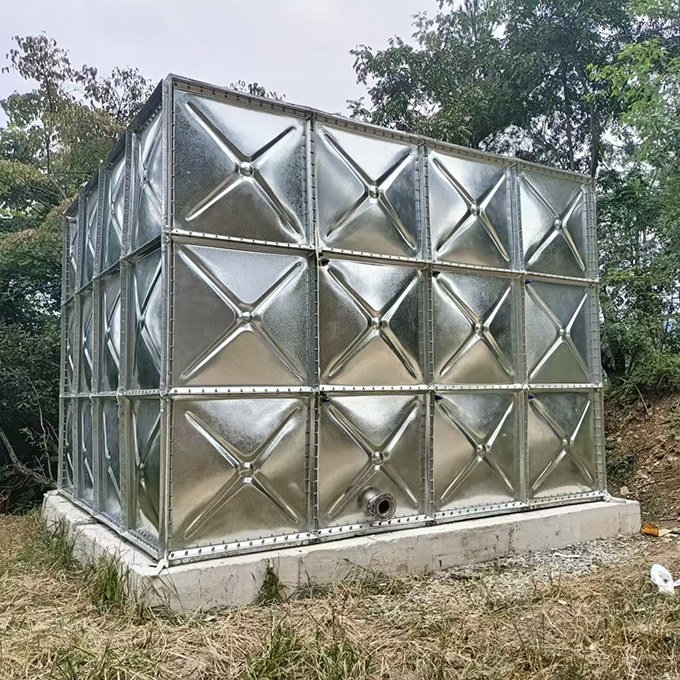
A hot-dip galvanized (HDG) steel bolted sectional water tank is a modular storage vessel made from mild steel panels that are punched, hot-dip galvanized after fabrication, and bolted together on site with sealed joints. The zinc coating is metallurgically bonded to the steel, so it protects the panel surface by sacrificial action rather than by a thin paint film. Panels are flat-packed for container export, carried to the tank base by a small crew, and assembled without welding or hot work. That combination — low installed cost, flat packing and no site welding — is why HDG sectional tanks are widely used for fire reserves, irrigation, stormwater, cooling-tower make-up and general industrial water.
LONGCOM supplies HDG bolted tanks as one of five tank families. The others are bolted stainless, welded stainless, glass-fused-to-steel (GFS) and BDF duplex-coated panels. HDG is the cost-sensitive choice when the water is neutral to mildly aggressive and the project can accept a zinc-coated wetted surface. For potable water in sensitive projects, or for chloride-rich and chemically aggressive duties, stainless or GFS is usually the better specification. The purpose of this page is to make that trade-off explicit before a quotation, not to present HDG as a universal tank.
What is an HDG bolted sectional tank?
The tank is a kit of factory-made panels, each with a formed edge, a punched bolt pattern and a matching seal strip. The panels are assembled in horizontal rings on a prepared base. Internal tie rods or external stays connect opposite walls, and the joints are sealed with gaskets and bolts. The result is a rigid box or cylinder-like envelope that can be built inside a building, on a roof, on a concrete plinth or on a steel tower, using hand tools and a modest lifting arrangement.
The important detail is the order of operations. The steel is cut and punched first, then the whole panel — including the drilled holes and formed edges — goes through the hot-dip galvanizing process. This is different from painting a finished panel. Hot-dip galvanizing covers the edges and the inside of the bolt holes, which are the places where a paint system normally fails first. The coating is also harder than most paint films and can tolerate the abrasion that occurs during transport and assembly.
HDG panels are not the same as “galvanized sheet” bought from a coil and fabricated afterwards. If a supplier cuts or welds a pre-galvanized sheet after coating, the cut edges and welds lose protection and must be repaired. For a bolted tank, the correct sequence is fabrication first, galvanizing second, with a coating mass and inspection record agreed for the project. Ask for the process route, not only the steel grade.
Where HDG tanks fit best
| Application | Why HDG fits | What to confirm before quoting |
|---|---|---|
| Fire water reserve | Large volumes at a lower cost per cubic metre than stainless; panels pack efficiently for export; no hot work at site. | Fire code, usable volume, refill rate, outlet arrangement, suction vortex protection and any insurer or authority requirement. |
| Irrigation storage | Remote sites and seasonal fill/draw cycles suit a robust, repairable panel tank; a local crew can assemble it. | Water source, silt and abrasion, wind load, base bearing, access road and whether a liner is needed for seepage or water quality. |
| Stormwater and detention | Cost-effective for intermittent duty where the water is not for drinking and the tank is not continuously full. | Design storm volume, inlet/outlet control, sediment accumulation, empty/refill frequency and cover or safety requirements. |
| Cooling-tower make-up | Neutral make-up water and a closed circuit are usually compatible with a zinc surface; the tank can be sized for buffer volume. | Water chemistry, cycles of concentration, biocide regime, temperature and whether blowdown or mixed water enters the tank. |
| General industrial water | Low capital cost and easy panel replacement where the duty is not strongly acidic or chloride-rich. | pH, chloride, sulphate, dissolved oxygen, process contamination, cleaning chemicals and discharge constraints. |
| Potable water — conditional | HDG is used in some markets, but zinc contact and local potable-contact rules must be checked. A food-grade liner or a stainless/GFS alternative may be required. | Local potable-contact approval, zinc limitation, liner specification, sampling plan and the authority having jurisdiction. |
HDG is a poor fit for continuous service with acidic water, high chloride, strong oxidants or repeated cleaning with aggressive chemicals. It is also a poor fit where the buyer treats the tank as a pressure vessel or where the water quality cannot tolerate any zinc contact. In those cases, the lower panel price is not the lowest installed cost, because a liner, a coating repair programme or an early replacement will consume the saving.
Panel and coating specification
An HDG tank quotation should describe the panel as a build-up, not as a single thickness number. The following table lists the items that should be fixed in writing. The values are typical ranges for discussion; the project calculation and the approved drawing set the final figures.
| Item | Typical range or option | Why it matters |
|---|---|---|
| Panel module | 1,000 × 1,000 mm, 1,000 × 500 mm or project-specific modules | Sets the bolt pattern, packing volume, panel weight and the number of joints. Non-standard modules increase tooling and lead time. |
| Steel thickness | 2.0–4.0 mm, selected by tank height, support spacing and load case | A thicker panel is not automatically better; the structural calculation must balance panel stiffness, tie rods, base supports and wind/seismic loads. |
| Steel grade | Structural mild steel to a stated standard | The certificate must show grade, heat number and thickness. Substitution without approval can fail a tender review. |
| Zinc coating mass | Typically 275–450 g/m² total, project-specific | Coating mass drives corrosion protection and service life. It must be stated as a mass per area, with an inspection method — not as “galvanized”. |
| Coating process | Hot-dip galvanizing after cutting, punching and edge forming | Ensures edges and bolt holes are coated. Post-fabrication touch-up must use a compatible repair method. |
| Joint sealing | EPDM or project-approved seal strip, with gaskets at fittings | The seal is the tank’s first barrier. Its hardness, compression and chemical compatibility must match the water and temperature. |
| Fasteners | Hot-dip galvanized or stainless bolts, washers and nuts | Mixed fastener materials can create galvanic corrosion and inconsistent torque. Specify the grade and the tightening procedure. |
| Tie rods / stays | Internal tie rods or external stays, sized to the load case | Tie rods carry the wall pressure. Their diameter, spacing and connection detail belong on the drawing, not in a generic brochure. |
| Connections | Inlet, outlet, drain, overflow, vent, level and ladder per drawing | Nozzle orientation and height determine whether the tank drains, vents and fills without creating a vortex or a dead zone. |
| Base interface | Concrete plinth, steel frame, roof curb or tower support | The tank supplier and the civil/steel designer must agree on level tolerance, anchor positions and load transfer. |
Do not accept a quotation that says only “HDG panel, 3 mm”. A complete line item states the module, steel grade, thickness, coating mass, seal material, bolt grade, tie-rod layout and the number of spare panels and seals. These items change the delivered cost even when the tank volume is identical.
Structural design, base and installation loads
A bolted tank is a structural system, not a pile of panels. The walls carry hydrostatic pressure, which increases with depth. The panel thickness, the tie-rod spacing and the stiffening at the corners must be designed together. The base must carry the full water load plus the tank, accessories, wind and any snow or seismic action. On a roof, the load is transferred through a curb or a frame; on a tower, the tower design and the tank base must be analysed as one system.
The foundation should be flat and level within the tolerance stated on the drawing. A grout bed is used to distribute load, not to correct a badly sloped slab. Anchor bolts or cast-in sockets should match the base ring or support beams. Where the tank is outdoors, the base should raise the panel bottom above standing water and allow air to circulate. If the site is coastal, avoid a carbon-steel base ring in direct contact with stainless or galvanized panels without an isolation detail; dissimilar-metal contact is a common source of staining and corrosion.
Wind and seismic design are project-specific. A tall, empty tank has a different load case from a short, full tank. The quotation should state the design wind speed, seismic parameters, snow load and any shelter or shielding assumption. If the buyer does not provide these values, the supplier should list them as missing inputs rather than guess. For elevated towers, the interaction between the tower, the tank and the piping must be checked by a qualified structural engineer.
HDG compared with stainless, GFS and BDF
| System | Best fit | Advantages | Limitations |
|---|---|---|---|
| HDG bolted steel | Fire, irrigation, stormwater, cooling make-up, general industrial water | Lowest panel cost among bolted options; robust coating; flat packing; no site welding; easy panel replacement. | Zinc surface is not universally accepted for potable water; limited resistance to strong acids, high chloride and some cleaning chemicals. |
| Bolted stainless (SS304/316) | Potable, food, pharmaceutical-adjacent, coastal or chloride-sensitive duties | No coating to repair; cleanable surface; good mechanical toughness; well understood by inspectors. | Higher panel cost; chloride stress corrosion is still possible in hot, concentrated conditions; welding and passivation must be controlled. |
| GFS bolted | Municipal potable, wastewater, effluent, biogas-adjacent, large industrial volumes | Factory-fired glass coating; good chemical resistance; long coating life; modular assembly. | Higher cost than HDG; coating can chip if panels are handled poorly; repair needs the approved kit; not universal for every chemical. |
| BDF duplex-coated | Potable, fire, rural water and industrial duties where a barrier coating over galvanized steel is accepted | Cost between HDG and GFS; robust substrate; barrier layer on the water side; flat packing. | Depends on the specific coating system and its approvals; field cuts need patching; not a substitute for GFS in aggressive chemistry. |
| Welded stainless | Seamless vessels, hygienic duty, tight sites, projects that prohibit bolted joints | No gasket joints in the shell; smooth interior; suitable for CIP and high hygiene. | Higher site skill and hot-work requirements; harder to transport; repair and modification are less modular. |
The correct comparison is not cost per cubic metre at the panel line. It is installed cost over the service life: foundation, lifting, assembly labour, seal replacement, coating repair, downtime and the risk of failing a water-quality or fire inspection. HDG wins many of those comparisons when the duty is simple and the site is remote. It loses when the water or the approval regime requires a different wetted surface.
Water chemistry and potable-water questions
Zinc is amphoteric: it can corrode in acidic water and in strongly alkaline water. The risk increases with chloride, dissolved oxygen, temperature and flow. A neutral, low-chloride water at ambient temperature is a very different duty from an acidic process stream or a hot, chloride-rich circulation. The project water analysis should include pH, chloride, sulphate, alkalinity, hardness, dissolved oxygen, temperature and any cleaning or dosing chemicals. If the analysis is not available, the quotation should state the assumption and require confirmation before fabrication.
For potable water, do not rely on a generic “food grade” statement. Ask for the specific local approval, the wetted-surface test report and the zinc limitation that applies in the country of installation. Some markets accept galvanized storage with conditions; others require a liner, stainless steel or a glass-coated surface. A food-grade liner can be fitted where the structure and the duty allow it, but the liner becomes the primary barrier and must be specified, installed and inspected as such.
For fire water, the key questions are usable volume, refill rate, outlet arrangement and the fire code. HDG is often acceptable because the water is not for drinking and the tank may be filled only for tests or emergencies. Even then, the tank must be protected against stagnation, and the outlet must avoid vortexing. A fire tank that holds the nominal volume but cannot deliver the required flow is not compliant, whatever the panel material.
Export packing and container planning
HDG panels are flat-packed in steel-framed crates or pallets, with panels numbered to the erection sequence. The packing list should show panel marks, dimensions, weights, crate numbers and the fastener/seal allowance. Small tanks may fit into a 20-foot container; larger tanks are planned across 40-foot high-cube containers. The container plan is not simply a volume calculation: panel weight, crate stacking, forklift capacity at site and the order of unloading all matter.
Seal strips and fasteners should be packed by tank and by assembly zone, not mixed in one unmarked box. A site crew that has to sort thousands of bolts before it can start is a hidden cost. Spare panels, spare seal strips and a repair kit should be included where the site is remote or where the buyer requests a maintenance allowance. The packing should also protect the panel edges and the galvanized surface from abrasion and moisture during transit.
Site installation sequence
| Stage | What happens | Hold point |
|---|---|---|
| 1. Base acceptance | Check level, dimensions, anchor positions, bearing capacity and drainage around the base. | Signed base acceptance before any panel is placed. |
| 2. First ring | Place the base panels, align the bolt holes, fit seal strips and tighten in the specified sequence. | Check diagonal dimensions and joint alignment. |
| 3. Wall rings | Add panels ring by ring, keeping the tank square/round and the joints sealed. | Check verticality and tie-rod positions at each ring. |
| 4. Tie rods / stays | Install and tension the internal or external system to the drawing. | Record torque or tension values. |
| 5. Connections | Fit inlet, outlet, drain, overflow, vent, level and ladder with correct gaskets. | Check orientation, height and access. |
| 6. Water-fill test | Fill in stages, inspect joints and connections, and check for leakage and deformation. | Test record with date, level and result. |
| 7. Handover | Clean, label valves, provide O&M, spare parts and test records. | Signed handover and maintenance schedule. |
The installation crew should have the approved drawing, the panel schedule, the torque procedure and the seal-strip instructions. A common error is to tighten one side of the tank before the opposite side, which pulls the panel grid out of alignment. Another is to fit the seal strip after the panels are already bolted, which can leave a gap at a corner. The sequence in the manual is there to protect the joints, not to slow the crew down.
Inspection, maintenance and repair
HDG tanks need a planned inspection routine, not a “fit and forget” approach. The first inspection should take place at handover, with a baseline record of joint condition, coating appearance, torque values and water quality. After that, inspect at least annually, and more often where the water is aggressive, the tank is outdoors in a coastal environment, or the tank is critical to fire protection. Look at seal strips for compression set, cracking or displacement; at bolts for corrosion or loosening; at the galvanized surface for white rust, red rust or abrasion; and at the base for cracking or settlement.
White rust (wet storage stain) can form on galvanized surfaces when water is trapped between panels during transport or when the tank is stored wet before assembly. It is a surface deposit, not necessarily a loss of coating, but it must be cleaned and the cause removed. Red rust indicates that the zinc layer has been breached; the area should be cleaned, assessed and repaired with a compatible method. Do not paint over an unprepared surface and call it repaired. For potable water, any repair material must be approved for the intended contact.
Seal strips are a wear item. Keep a spare set in the maintenance store, especially for remote sites. Replace a seal if it is cracked, permanently deformed, chemically swollen or leaking. When a panel is damaged, the modular system allows it to be unbolted and replaced, but the adjacent joints and the tie rods must be checked at the same time. A repair that restores the panel but leaves a distorted joint can create a new leak path.
What to include in an HDG tank RFQ
Send the following inputs in one message where possible. The quotation can then be specific rather than a range:
- Capacity or dimensions, and whether the volume is nominal, effective or fire usable volume.
- Application and water source: potable, fire, irrigation, stormwater, cooling, process or wastewater.
- Water analysis: pH, chloride, sulphate, alkalinity, hardness, dissolved oxygen, temperature and any dosing chemicals.
- Site location, indoor/outdoor, coastal or industrial exposure, wind/snow/seismic parameters and base type.
- Connection sizes and positions, inlet/outlet/drain/overflow/vent, level control and ladder access.
- Destination port, Incoterm, container constraints, site access and lifting equipment.
- Tender standard, inspection requirement, documentation pack and any potable-contact or fire approval.
Quality and documentation
The inspection plan should be agreed before production. For a standard HDG tank, the usual records are: steel mill certificate with grade and heat number; panel dimensional inspection; coating mass or coating thickness record; bolt and seal material certificates; trial assembly where specified; water-fill test record; packing inspection and loading photos; and the installationmanual with torque values and maintenance schedule. If third-party inspection is required, the hold points and witness points should be written into the purchase order.
Certification is different from inspection. A test record proves what was checked on this order. A certificate proves that a product, factory or process has been assessed by a recognised body. Do not accept a certificate number that does not name the product and factory, and do not accept a “food-grade” claim without the document that supports it for the destination market. Where a required certificate is not held for the proposed tank, the quotation should say so before award, not after the tank is shipped.
Frequently asked questions
What is the design life of a hot-dip galvanized panel tank?
There is no single design life for HDG. The service life depends on the coating mass, the water chemistry, the temperature, the fill/draw cycle and the external environment. A neutral, low-chloride water in a sheltered site is a much easier duty than an acidic or chloride-rich water in a coastal plant. LONGCOM states the coating mass and the assumed water conditions in the quotation, and confirms the expected service figure for the project in writing. The buyer should compare that figure with the required design life, not with a generic “20 years” claim.
Can HDG tanks be combined with a liner?
Yes. An internal liner can be fitted where the duty requires a barrier between the water and the zinc surface, or where the local potable-water rule requires it. The liner specification, fixing method, seam detail, penetration details and inspection procedure must be part of the quotation. A liner is not a substitute for correct panel selection; if the water is aggressive enough to attack the liner, the underlying material and the liner system both need review.
What maintenance does an HDG tank need?
Inspect joints, seals, bolts, coating and base at least annually. Clean the tank and remove sediment on a schedule that matches the water quality. Check the vent, overflow and level devices. Replace seal strips when they show cracking, swelling or permanent deformation. Keep a small stock of seals, bolts and repair materials. A maintenance schedule and a handover record should be supplied with the tank; the schedule should state what to check, how often and what counts as a defect.
Do HDG tanks suit elevated tower installations?
Yes, but the tower and the tank must be designed together. The tower must carry the full water load, wind load and seismic load, and the tank base must match the tower’s support points. The tank supplier should provide the base interface drawing, anchor positions and load data to the tower designer. Do not select a tank and a tower separately and assume the interfaces will match on site.
What is included in the shipping package?
Panels, bolts, nuts, washers, seal strips, tie rods or stays, connection fittings, fasteners for accessories, the approved drawing, the panel schedule, the installation manual and the packing list. Ladders, level indicators, floats and other accessories are included when they are in the quotation. The packing list should identify each crate, panel mark and accessory box so that the site can receive and check the shipment without opening every crate.
Can you match an existing tank dimension?
Yes, panels are punched to order, so a replacement or extension can be made to match an existing grid where the drawings and site dimensions are available. Send the existing tank drawing, photos of the joints and base, and the measured internal dimensions. The supplier must confirm panel compatibility, seal detail and tie-rod layout; a visually similar panel may not be interchangeable if the punch pattern or edge profile differs.
Is HDG suitable for fire water?
It is commonly used for fire reserves, but the fire code and the insurer’s requirements still govern. Confirm the usable volume, refill rate, outlet arrangement, suction conditions, inspection access and any requirement for a potable or coated surface. The tank must be able to deliver the design flow, not merely hold the nominal volume. If the authority requires a specific wetted surface or a lining, HDG may not be acceptable without modification.
How does HDG compare with a painted steel tank?
Hot-dip galvanizing coats the edges and bolt holes and forms a metallurgical bond with the steel. A paint system is a barrier film that depends on surface preparation, primer, adhesion and site repair. HDG is generally more tolerant of rough handling and minor abrasion, but it is not immune to acid, chloride or wet storage stain. A painted tank can offer a wider colour range and a specific chemical barrier, but its performance depends on the coating system and the quality of application. Compare the full build-up and the inspection records, not the label.
Can HDG panels be repaired on site?
Minor coating damage can be repaired with a compatible zinc-rich repair method after cleaning and preparing the area. Structural damage or a breached panel should be replaced. The repair procedure, the approved materials and the acceptance criteria should be in the handover pack. For potable water, the repair material must be suitable for contact with drinking water; a generic industrial paint is not acceptable.
What water quality is unsuitable for HDG?
Strongly acidic water, high-chloride water, water with aggressive oxidants, and repeated cleaning with acidic or strongly alkaline chemicals are all reasons to review the material. The exact limits depend on temperature, concentration and exposure time, so a water analysis and a cleaning regime are needed. If the buyer cannot provide the analysis, the quotation should state the assumption and require confirmation before fabrication.
How are panels packed for export?
Panels are packed in steel-framed crates or on pallets, with edge protection and moisture protection. Panels are numbered to the erection sequence, and fasteners and seals are packed by tank and zone. The container plan shows crate weights, stacking and unloading order. For remote sites, include spare seals, bolts and a repair kit; the cost is small compared with a shutdown caused by a missing part.
What documents are supplied?
The standard pack includes the approved general arrangement drawing, panel schedule and erection sequence, steel and coating records, bolt and seal certificates, water-fill test record, packing list, installation manual and warranty document. Third-party inspection records are added when the purchase order requires them. Certificates are supplied only where a valid certificate covers the proposed product and factory.
Capacities, panel sizes, material grades, coating mass, test scope, packing and lead times are confirmed in writing for each project before quoting. This page describes the HDG system; it does not certify a particular tank or approve it for a particular water. The approved drawing and the project specification govern.
Buyer terminology: what this product is called in different markets
The same product is searched under different English names in different regions. The table below records the names buyers actually use, so a specification or RFQ is not lost to a literal translation.
Primary English name: Hot-dip galvanized steel bolted sectional water tank
Also searched as: HDG sectional water tank · galvanized steel water tank · galvanised steel sectional tank · zinc-coated steel water tank · galvanized panel tank.
| Market | Common English search name |
|---|---|
| United States & Canada | hot-dip galvanized steel water tank; galvanized bolted tank |
| United Kingdom & Ireland | galvanised steel sectional water tank; galvanised panel tank |
| Middle East & GCC | HDG sectional water tank; galvanized panel water tank |
| Southeast Asia | galvanized modular water tank; galvanized sectional tank |
| India & South Asia | hot dip galvanized sectional water tank; galvanized panel tank |
| Africa | galvanized steel water storage tank; sectional steel tank |
| Australia & New Zealand | galvanised steel modular tank; galvanised sectional tank |
Attribute and application terms: heavy zinc coating, corrosion-resistant, economical, modular, flat-packed, fire-water and irrigation duty. Typical duties include fire water reserve, irrigation, agriculture, mining water supply, industrial storage, temporary and construction water.
Long-tail search phrases
- hot dip galvanized sectional water tank for fire water reserve.
- galvanised steel modular tank for irrigation projects.
- HDG panel tank for mining camp water supply.
- economical galvanized water tank for industrial storage.
- flat packed galvanized sectional tank for export.
Use “galvanized” for US and international English, “galvanised” for UK, Irish and Australian searches. “Zinc-coated” is a descriptive synonym, not a separate coating system.
Related products and systems
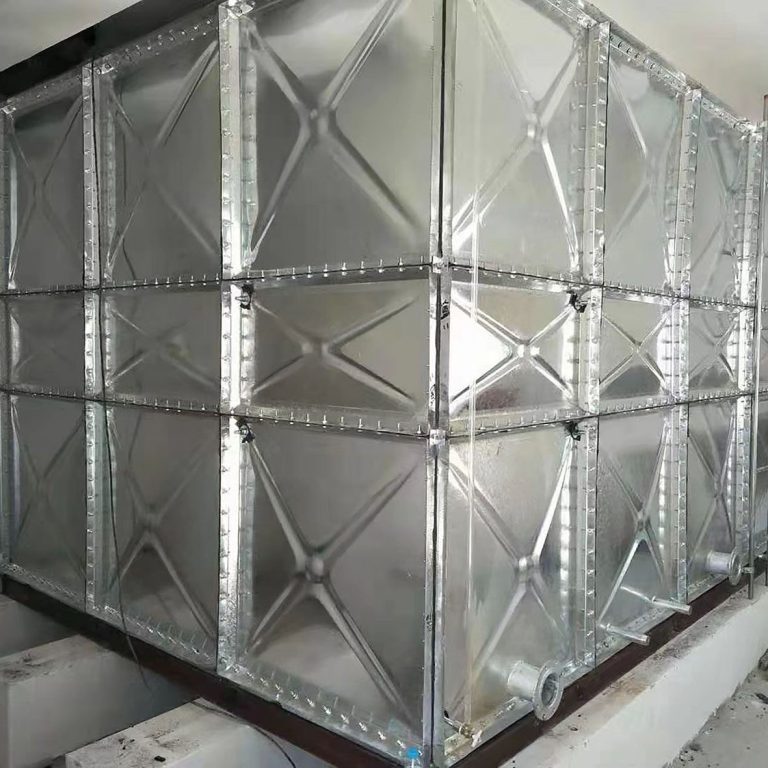
Bolted Stainless Steel Sectional Water Tank (SS304 / SS316)
Bolted stainless steel sectional water tank (SS304/316), also called modular or panel tank: flat-packed panels for potable, fire and process storage.
SS304 / SS316 stainless steelHot-Dip Galvanized (HDG) Steel Bolted Sectional Water Tank
Hot-dip galvanized steel bolted sectional water tank (HDG / galvanised panel tank) for fire, irrigation and industrial water: flat-packed for export.
Hot-dip galvanized mild steel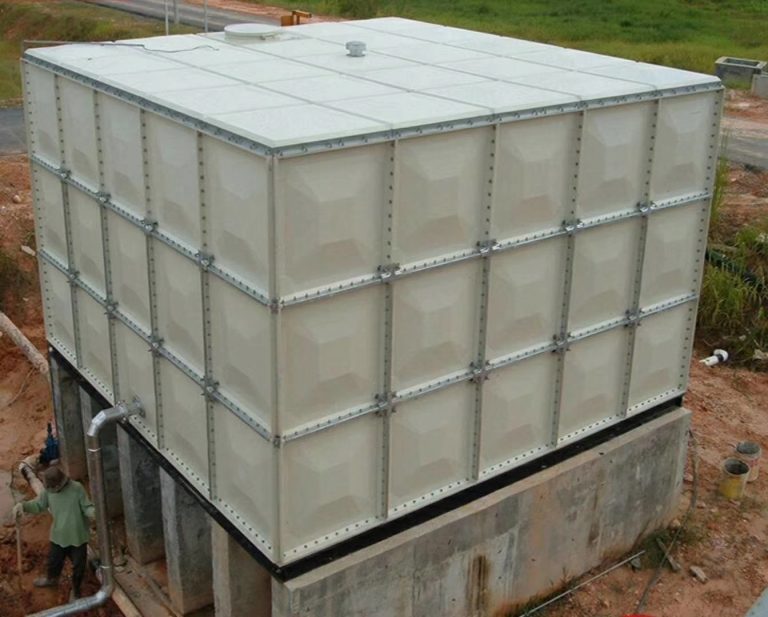
Glass-Fused-to-Steel (GFS) Sectional Water Tank
Glass-fused-to-steel (GFS) sectional water tank: factory-fused glass coating on bolted panels for municipal, wastewater, biogas and industrial storage.
Steel sheet with factory-fired glass (glass-fused-to-steel)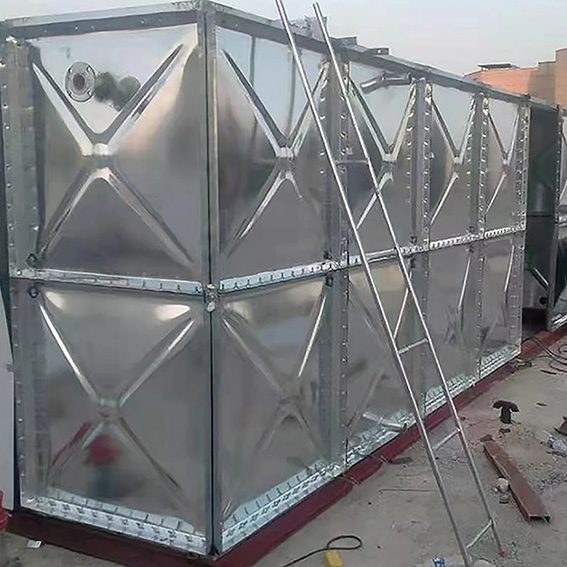
Duplex-Coated Galvanized Steel Panel Water Tank (BDF)
Duplex-coated galvanized steel panel water tank (BDF) for potable, fire and rural water: modular, flat-packed and available with a project-approved coating.
Hot-dip galvanized steel with bonded protective coating (duplex)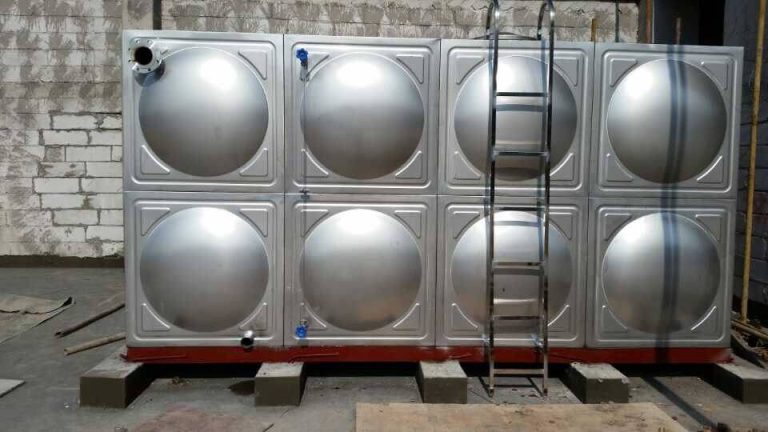
Welded Stainless Steel Water Tank (304 / 316)
Welded stainless steel water tank (SS304/316L) for potable, food, pharmaceutical and process duty, with factory or site welding and export documentation.
SS304 / SS316 / SS316L stainless steel, welded construction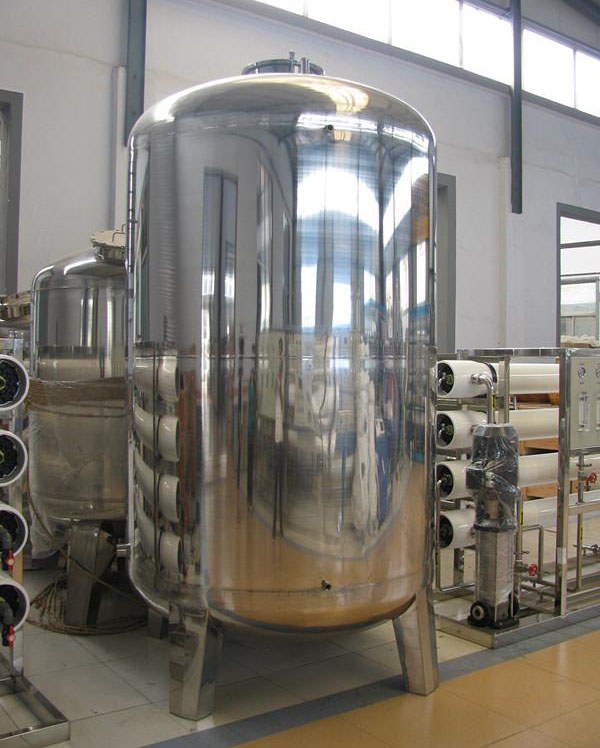
Aseptic Stainless Water Tank (SS304 / SS316L)
Aseptic stainless steel water tank (sterile/pharmaceutical purified water tank) in SS316L with 0.22 micron vent, CIP/SIP and nitrogen option.
SS304 / SS316L hygienic stainless steel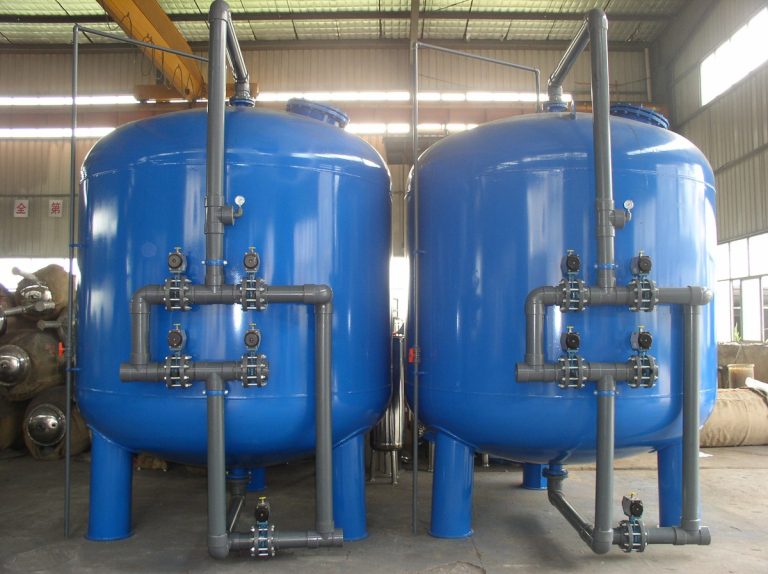
Mechanical Media Water Filter (Sand, Anthracite, Manganese, Carbon)
Mechanical media water filter, also called pressure sand filter or multimedia filter: steel, stainless or FRP vessels for turbidity and RO/UF pretreatment.
Epoxy-coated carbon steel; SS304/316; FRP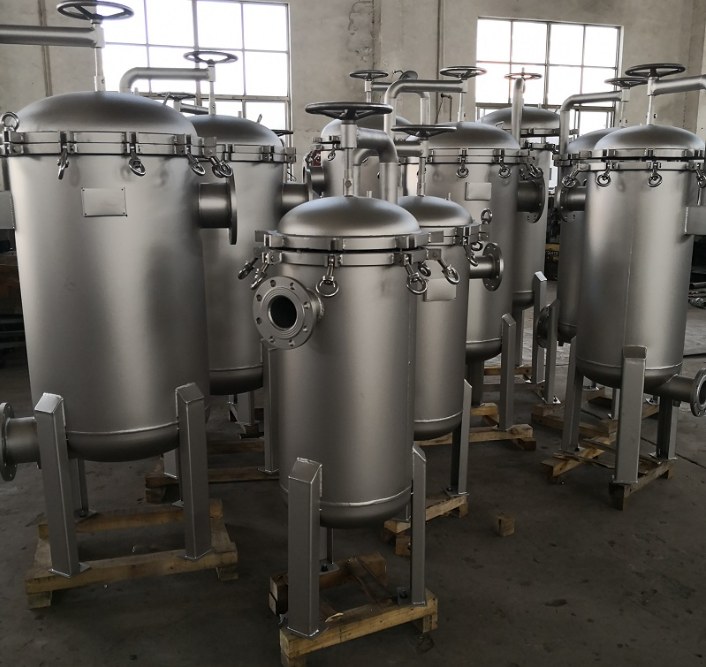
Bag Filter for Water Treatment (1-100 micron)
Liquid bag filter housing for water treatment: single and multi-bag units in carbon steel, SS304/316L or PP for RO guard and process…
Carbon steel, SS304/316L, PP; NBR/EPDM/FKM/silicone sealsFrequently asked questions
What is the design life of a hot-dip galvanized panel tank?
There is no single figure. Service life depends on coating mass, water chemistry, temperature, fill/draw cycle and external exposure. A neutral, low-chloride water in a sheltered site is a much easier duty than an acidic or chloride-rich water in a coastal plant. LONGCOM states the coating mass and assumed water conditions in the quotation and confirms the expected service figure for the project in writing.
Can HDG tanks be combined with a liner?
Yes. An internal liner can be fitted where the duty requires a barrier between the water and the zinc surface, or where local potable-water rules require it. The liner specification, fixing method, seam detail, penetration details and inspection procedure must be included in the quotation. A liner is not a substitute for correct panel selection.
What maintenance does an HDG tank need?
Inspect joints, seals, bolts, coating and base at least annually, and more often in aggressive or coastal service. Clean the tank and remove sediment on a schedule that matches the water quality. Check the vent, overflow and level devices. Replace seal strips when they crack, swell or remain deformed, and keep a small stock of seals, bolts and repair materials.
Do HDG tanks suit elevated tower installations?
Yes, but the tower and tank must be designed together. The tower must carry the full water load, wind load and seismic load, and the tank base must match the tower support points. The tank supplier should provide the base interface drawing, anchor positions and load data to the tower designer before fabrication.
What is included in the shipping package?
Panels, bolts, nuts, washers, seal strips, tie rods or stays, connection fittings, accessory fasteners, the approved drawing, panel schedule, installation manual and packing list. Ladders, level indicators, floats and other accessories are included when they are in the quotation. The packing list identifies each crate, panel mark and accessory box for site receipt.
Can you match an existing tank dimension?
Yes. Panels are punched to order, so a replacement or extension can be made to match an existing grid where drawings and site dimensions are available. Send the existing drawing, photos of the joints and base, and measured internal dimensions. The supplier must confirm panel compatibility, seal detail and tie-rod layout; a visually similar panel may not be interchangeable.
Is HDG suitable for fire water?
It is commonly used for fire reserves, but the fire code and insurer requirements still govern. Confirm usable volume, refill rate, outlet arrangement, suction conditions, inspection access and any required wetted surface. The tank must deliver the design flow, not merely hold the nominal volume. If a lining or a different surface is required, HDG may need modification.
How does HDG compare with a painted steel tank?
Hot-dip galvanizing coats the edges and bolt holes and forms a metallurgical bond with the steel. Paint is a barrier film that depends on surface preparation, primer, adhesion and site repair. HDG is generally more tolerant of rough handling and minor abrasion, but it is not immune to acid, chloride or wet storage stain. Compare the full build-up and inspection records, not the label.
Can HDG panels be repaired on site?
Minor coating damage can be repaired with a compatible zinc-rich method after cleaning and preparing the area. Structural damage or a breached panel should be replaced. The repair procedure, approved materials and acceptance criteria should be in the handover pack. For potable water, the repair material must be suitable for drinking-water contact.
What water quality is unsuitable for HDG?
Strongly acidic water, high-chloride water, aggressive oxidants and repeated cleaning with acidic or strongly alkaline chemicals are reasons to review the material. The limits depend on temperature, concentration and exposure time, so a water analysis and cleaning regime are needed. If the buyer cannot provide the analysis, the quotation should state the assumption and require confirmation before fabrication.
How are panels packed for export?
Panels are packed in steel-framed crates or on pallets with edge and moisture protection. They are numbered to the erection sequence, and fasteners and seals are packed by tank and zone. The container plan shows crate weights, stacking and unloading order. For remote sites, include spare seals, bolts and a repair kit; the cost is small compared with a shutdown caused by a missing part.
What documents are supplied?
The standard pack includes the approved general arrangement drawing, panel schedule and erection sequence, steel and coating records, bolt and seal certificates, water-fill test record, packing list, installation manual and warranty document. Third-party inspection records are added when the purchase order requires them. Certificates are supplied only where a valid certificate covers the proposed product and factory.