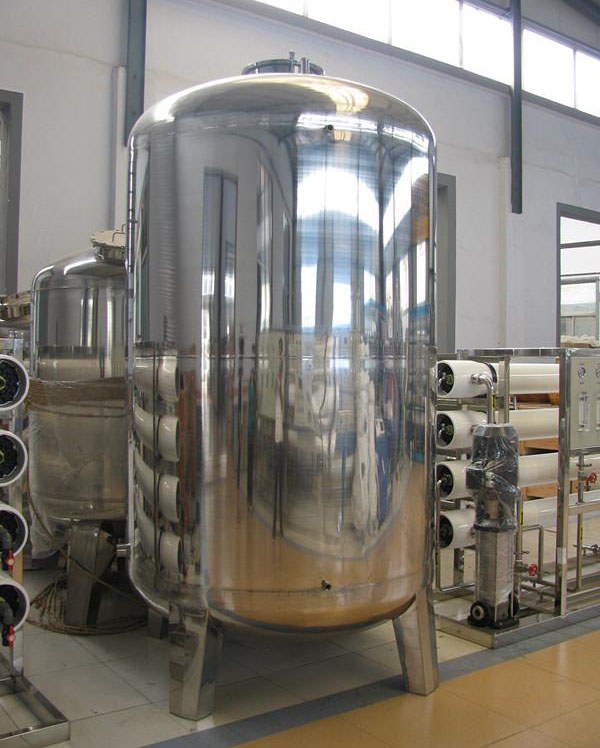
Aseptic and hygienic storage is a product family for water that has already been treated and must stay clean until it is used. The vessel is closed, vented through a filter, internally finished and detailed for cleaning. It is not a treatment process and it is not a steriliser; it protects water quality after the treatment plant has done its job.
LONGCOM supplies closed SS304 and SS316L tanks from 0.5 m³ to 50 m³ as standard, with mechanical polish Ra ≤0.8 μm, optional electrolytic polish Ra ≤0.4 μm, 0.22 μm hydrophobic PTFE breathers, CIP connections and optional nitrogen blanketing. The family is used for pharmaceutical purified-water buffers, food and beverage process water, direct-drinking systems, cosmetics, electronics ultrapure-water pre-storage and laboratory water.
The four controls that define the family
| Control | Design response | What the buyer should verify |
|---|---|---|
| Keep air out | Closed vessel, sealed manway, sealed connections, filtered vent. | Breather rating, size and replacement interval; manway seal material. |
| Keep the surface cleanable | SS304/316L, internal polish, dressed welds, no dead pockets. | Ra value, inspection method, weld and passivation records. |
| Allow cleaning | Spray ball / CIP connection, drain slope, access. | Spray coverage, drainability, cleaning procedure and sampling points. |
| Protect the vessel | Pressure/vacuum protection, level and temperature connections. | Design pressure, relief arrangement, instrument range and installation detail. |
Standard specification envelope
| Parameter | Standard range | Project-specific |
|---|---|---|
| Effective volume | 0.5–50 m³ | Larger custom vessels by layout and transport review. |
| Material | SS304 (06Cr19Ni10); SS316L (022Cr17Ni12Mo2) | Other grades only where the water chemistry requires and the material is available. |
| Inner surface | Mechanical polish Ra ≤0.8 μm | EP Ra ≤0.4 μm; weld dressing and passivation. |
| Design pressure | Atmospheric or 0.1–0.6 MPa | Higher pressure requires a separate design and inspection scope. |
| Design temperature | 4–60 °C | Higher temperature depends on seals, insulation and rating. |
| Vent filter | 0.22 μm hydrophobic PTFE | 0.45 μm, duplicate breather or heated jacket where specified. |
| Connections | Sanitary clamp, flange or welded | Standard and orientation fixed on the approved drawing. |
| Cleaning | Spray ball / CIP, drain | Rotary spray ball, multiple points, CIP return. |
| Options | Nitrogen blanketing, UV/ozone, level transmitter, insulation | Only where the process and safety review support the option. |
Where the family fits
- Pharmaceutical purified water: buffer storage downstream of RO or distillation, with a validated cleaning and sampling regime.
- Food and beverage: ingredient water, beverage make-up, rinse water and CIP make-up.
- Direct drinking: filtered drinking-water storage in schools, hospitals, hotels and residential communities.
- Cosmetics and personal care: purified process water where microbial control is required.
- Electronics: ultrapure-water pre-storage before polishing loops.
- Laboratory and small water stations: closed, cleanable purified-water storage.
The family is not suitable as the first treatment step for raw surface water, sewage or high-turbidity water. Those sources need clarification, filtration and disinfection upstream.
How this family connects to water treatment
Aseptic storage normally sits downstream of treatment. If the feed has turbidity or suspended solids, a mechanical media filter or a bag filter should protect the storage step. The filter removes particles; the aseptic tank protects the treated water from recontamination. They are different duties and should not be substituted for each other.
Documentation and certification position
Material certificates, weld records, pressure-test records, surface-roughness records, passivation records and O&M instructions can be supplied as agreed. A GMP compliance statement, a pharmacopoeia validation, an NSF/ANSI 61 certificate or a WRAS approval is not claimed unless a valid document covers the proposed product and scope. For GMP-regulated projects, the final documentation and surface finish should be agreed against the user’s validation protocol before fabrication.
Hygienic and aseptic tank FAQ
Is an aseptic tank a steriliser?
No. It stores treated water and reduces recontamination through a closed vessel, filtered vent and cleanable surface. Sterilisation or disinfection is a separate process such as UV, ozone, heat or chemical treatment.
SS304 or SS316L?
SS304 is common for neutral, low-chloride drinking and food water. SS316L is selected for higher chloride, purified or slightly acidic water, aggressive cleaning chemicals or a project specification. The water analysis and cleaning regime should decide.
What finish can you provide?
Mechanical polish Ra ≤0.8 μm is standard. Electrolytic polish Ra ≤0.4 μm is available where specified. Weld dressing and passivation are part of the finish scope, not an optional cosmetic.
Can the tank include CIP and nitrogen?
Yes, where the process and safety review support it. CIP coverage, drain slope, gas controls, relief and instrumentation should be designed together. Nitrogen is an asphyxiation hazard and requires a safe venting procedure.