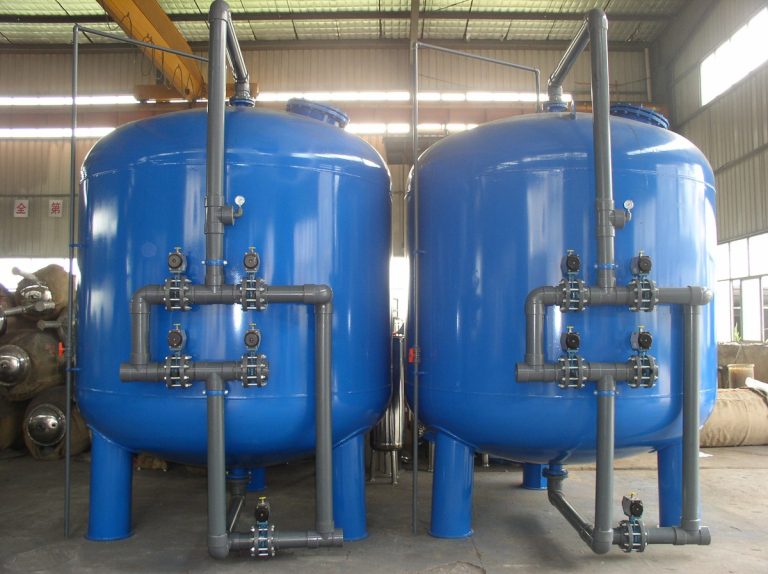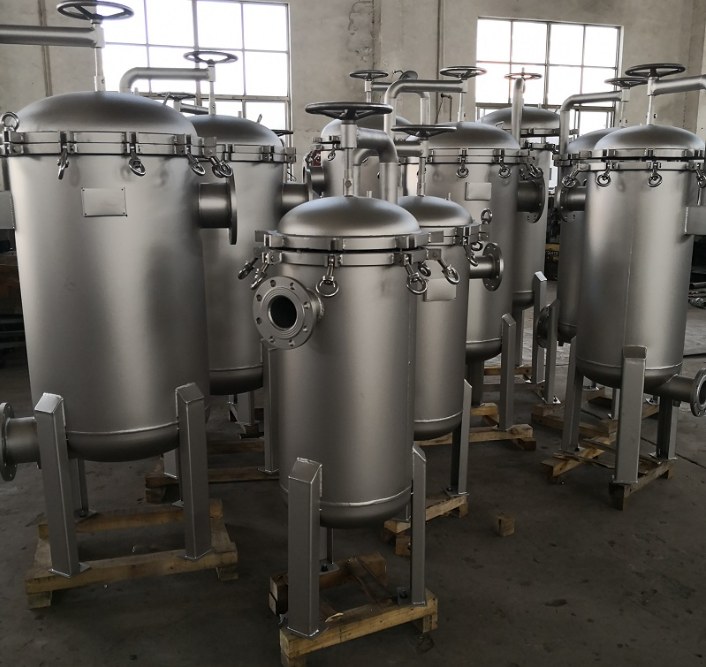
Water treatment filters remove particles, turbidity, iron, manganese, chlorine or fine solids before storage, membranes or process equipment. LONGCOM supplies two complementary families: pressure media filters with granular beds, and bag filters with quick-change filter bags. They are often used together, but they solve different problems.
Media filters handle higher solids loads, turbidity and backwashable duty. Bag filters provide finer polishing, lower capital cost at small flows and fast change-out. Selecting one without checking the feed quality, the downstream target and the maintenance plan usually ends in either a blocked membrane or an over-sized filter that is never operated correctly.
Media filter or bag filter?
| Question | Mechanical media filter | Bag filter |
|---|---|---|
| Primary duty | Turbidity, suspended solids, iron/manganese with the right media, chlorine with carbon. | Fine particle capture and polishing, typically 1–100 μm. |
| Solids load | Better for higher loads; backwashable. | Better for low to moderate loads; bag replacement instead of backwash. |
| Fineness | Typically coarser than a fine bag; depends on media. | Can go down to 1 μm, but finer bags load faster. |
| Maintenance | Backwash, media inspection and periodic replacement. | Differential-pressure monitoring and bag change-out. |
| Best position | Bulk removal, RO/UF pretreatment, surface-water clarification. | Guard filtration before membranes, heat exchangers, nozzles or distribution. |
| Watch-out | Needs backwash water and drain capacity; media can channel or compact. | Not a clarifier; high solids load causes frequent bag changes. |
Media filter selection inputs
Start with design flow, inlet turbidity or iron/manganese, required outlet quality, operating pressure and temperature, and the available backwash water and drain. The bed area follows A = Q / v, with 8–12 m/h as a starting band for single-media sand. Check the vessel diameter, media depth, freeboard and backwash expansion together.
Media choice follows the duty: quartz sand for turbidity and suspended solids; anthracite for coarse solids and longer run length; manganese sand for iron and manganese with the right oxidation and pH; activated carbon for chlorine, taste, odour and some organics. A multi-media bed can combine coarse and fine layers, but it is not automatically better than a single well-graded bed.
Bag filter selection inputs
Start with flow, fluid, viscosity, temperature, particle size and allowable pressure drop. A size 2 bag has about 0.5 m² of area and 33 L volume; in clean water at 25 μm, a practical reference is 20–40 m³/h per bag. Apply a safety factor of 1.2–1.5, then round up to the standard housing. If the result exceeds about 12 bags, split the duty into two smaller housings for maintenance.
Rating follows the downstream protection: 5–10 μm for RO/UF guards, 25–50 μm for circulating-water side-stream, 50–100 μm for coarse protection. Finer is not automatically better; it raises pressure drop and bag consumption.
Where the family fits
- RO and UF pretreatment: media filtration for the bulk load, bag filtration as the guard.
- Industrial process water: turbidity, iron/manganese and chlorine reduction before use.
- Water reuse: tertiary solids removal and polishing before disinfection or membranes.
- Food and beverage: process-water clarification and polishing with compatible materials.
- Swimming pools: particulate removal ahead of disinfection.
- Cooling and HVAC: make-up and side-stream filtration to protect heat exchangers and nozzles.
System design and documentation
Provide pressure gauges or differential-pressure transmitters across the filter, sampling points, isolation valves and a drain route that cannot back-siphon into the treated-water line. For automatic media filters, confirm the valve schedule, differential-pressure set point and fail-safe position. For bag filters, confirm the clean differential pressure and the change-out threshold.
Material certificates, pressure-test records, media or bag specification data and O&M instructions can be supplied as agreed. NSF/ANSI 61, WRAS, CE or other product certification is not claimed unless a valid document covers the specific product and scope.
Water treatment FAQ
Do I need both a media filter and a bag filter?
Often yes. The media filter removes the bulk solids load and is backwashable; the bag filter provides finer protection and is quick to change. Using only a bag filter on a high-solids feed causes frequent change-outs; using only a media filter may not protect a fine membrane.
What flow can one media filter handle?
The LK-SYSL range covers about 2–100 m³/h across the series, but a single vessel at the standard 8–12 m/h band is limited by its cross-sectional area. A Φ2500 vessel handles about 39–59 m³/h at that band; higher flows use multiple vessels or a project-specific velocity review. Check the backwash, pressure drop and inlet solids before fixing the flow.
How fine can a bag filter go?
Standard ratings are 1, 5, 10, 25, 50 and 100 μm. A 1 μm bag is a polishing filter, not a sterilising filter, and it loads quickly. Match the rating to the particle size you need to remove and the downstream equipment you are protecting.
Can the filters be supplied in stainless steel?
Yes. SS304 or SS316L vessels are available for potable, food, pharmaceutical or corrosive duty. Carbon steel with epoxy coating is the economic choice for neutral industrial water. FRP is an option for corrosive media within its pressure and temperature limits.